
To publish a book for free online and worldwide, you can use self-publishing or print-on-demand publishing services that distribute books internationally in digital and print formats.
Modern publishing platforms allow writers to upload manuscripts, receive ISBN support, and make books available to global readers without upfront publishing costs.
International publishing companies such as Omniscriptum support authors across multiple genres, languages, and publishing formats, including academic publishing, fiction, specialist literature, children’s books, and multilingual titles.
How to Publish Your Book for Free Online in 5 Steps
Step 1: Finish and Proofread Your Manuscript – Before anything else, proofread your manuscript thoroughly. Errors in spelling, punctuation, and formatting damage your credibility and hurt reviews. A clean manuscript also allows your editor to focus on deeper improvements rather than surface corrections.
Step 2: Choose a Publisher That Matches Your Goals – Choose a publisher that aligns with your goals, audience, and budget. Free ISBN publishing is available through platforms like Amazon KDP, Draft2Digital, and OmniScriptum — each differing in editorial support, distribution reach, and language availability.
Step 3: Prepare Your Manuscript — Format and Design Without Spending Money – Use free tools like Google Docs, LibreOffice, Canva, and Reedsy Book Editor to format your manuscript professionally at zero cost. Always follow your chosen publisher’s specific submission and formatting guidelines before uploading.
Step 4: Make Your Book Discoverable in AI Search – Write a semantically descriptive title and subtitle, optimize your metadata, and distribute content across multiple platforms. Following Google I/O 2026, AI search now processes multimodal inputs, meaning your cover, description, and metadata all affect how your book gets found globally.
Step 5: Submit or Publish Your Manuscript – Submit your manuscript and let your publisher handle distribution. Once live, share your listing, build your author profile, write supporting content, and gather reviews — because publishing is not the finish line, it is the starting line.
Top Free Book Publishing Platforms Comparison Based on Your Goal and Publishing Type
| Publishing Type | Best For | Publishers and Platforms | Main Advantages |
|---|---|---|---|
| Academic Publishing | Research papers, theses, dissertations, and scientific books | Lambert Academic Publishing | Academic-focused publishing, international distribution, ISBN support |
| Fiction and Novel Publishing | Fiction, fantasy, romance, literary works | JustFiction! Edition, Amazon KDP, Ingram Content Group | Global print-on-demand and bookstore distribution |
| Ebook Self-Publishing | Independent ebook publishing | Amazon KDP | Ebook royalties, print-on-demand support, worldwide reach |
| Multi-Store Ebook Distribution | Wide ebook retailer distribution | Omniscriptum | Book distribution across multiple ebook stores, Amazon KDP, |
| Serialized Story Publishing | Community-driven fiction publishing | Wattpad | Audience engagement and serialized storytelling |
| Educational and Expertise Publishing | Guides, educational content, professional expertise | Medium, Substack | Audience building and authority publishing |
| Motivation and Personal Development Publishing | Coaching, mindset, wellbeing, self-improvement books | Vitascript Press | Specialized publishing for coaching and motivational topics |
| Religious and Spiritual Publishing | Faith-based books, theology, spiritual writing | Blessed Hope Publishing | Religious and spiritual publishing focus |
| Specialist and Niche Publishing | Politics, history, wellbeing, lifestyle, niche subjects | Omniscriptum – specialized international book publisher with many imprints | Research papers, theses, dissertations, scientific and fiction books |
What Does “Publishing a Book for Free” Actually Mean?
Publishing a book for free means you pay nothing out of pocket to get your book out into the world.
Here’s what that actually looks like in practice:
- No upfront costs. You don’t pay a publisher, a printing house, or a distribution company to make your book available to readers. Traditional presses used to charge authors thousands of dollars just to see their work in print.
- Using platforms that charge nothing to upload. Services like Amazon KDP, Omniscriptum, and Smashwords let you create an account, upload your manuscript and cover, and start selling – all at zero cost. They make their money by taking a percentage of your royalties only when you actually sell something.
- Skipping the gatekeepers. It also means bypassing the traditional publishing route, where you’d need a literary agent, a publishing deal, and sometimes years of waiting – a process that can involve its own indirect costs like query fees or editorial services.
What it does NOT mean:
- Your book is free for readers to download (that’s your choice to make).
- You give up ownership of your work.
- You earn nothing – platforms still pay you royalties per sale.
In short, free publishing simply means the cost to publish sits at zero on your end – the platform shoulders the infrastructure, and you keep a share of every sale. It flips the old publishing model on its head – instead of paying to be published, you get paid because you published.
Traditional Publishing vs Self-Publishing vs Hybrid Publishing
There are three main types of publishers and publishing models Traditional, Self-Publishing and Hybrid Publishing
The three models differ mainly in cost, control, and royalties. Traditional publishing is free to the author and fully handled by a major house like Penguin or HarperCollins, but you earn low royalties of around 8–15% and have very little creative control, and getting accepted is extremely difficult. Self-publishing through platforms like Amazon KDP puts all the responsibility on you but gives you full control and up to 70% royalties with no gatekeepers.
Hybrid publishing sits in the middle, and OmniScriptum is a strong example of this, they publish authors across all genres at zero cost, provide strong editorial support by assigning each author their own dedicated editor, work across many languages, and handle all distribution and print-on-demand logistics so the author focuses on their manuscript.
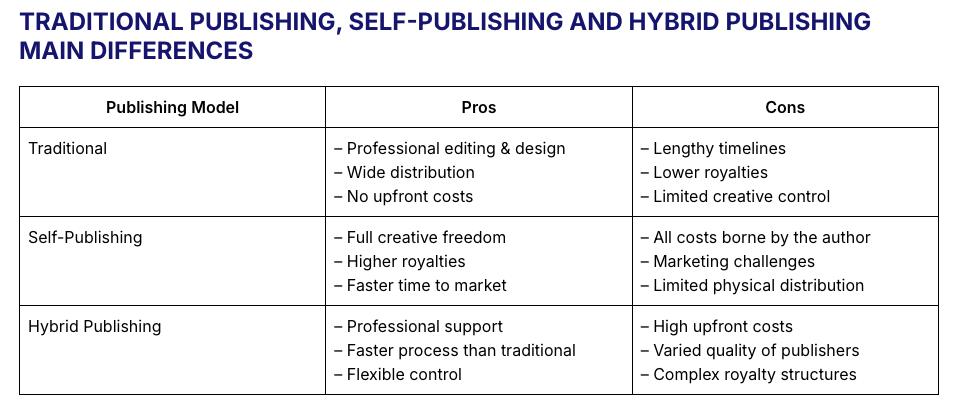
Source: SELF-PUBLISHING VS TRADITIONAL VS HYBRID PUBLISHING GUIDE
How to Choose the Right Publishing Path for Your Book Type?
The simple rule of thumb when choosing the right publishing path depends on your wants.
Want prestige and bookstore reach → Traditional Publishing
Want full control and maximum royalties → Self-Publishing
Want professional support with better royalties → Hybrid Publishing
How to Become a Published Author in 5 Easy Steps and Publish Your Book for Free
1. STEP: Finish and Proofread Your Manuscript
Proofreading your manuscript before publishing your book for free or putting a book online is essential. Errors in spelling, punctuation, and formatting can damage your credibility and hurt your reviews – no matter how strong your content is.
If you are self-publishing on KDP, there is no editorial team to catch mistakes, so the responsibility is entirely yours. If you are publishing through OmniScriptum, arriving with a clean manuscript means your dedicated editor can focus on greater improvements rather than surface corrections. Across every publishing path, a proofread manuscript shows professionalism, respect for your reader, and gives your book the strongest possible start.
2. STEP: Choose a Publisher That Matches Your Goals
Once your manuscript is proofread and ready, the next step is choosing the right publisher, one that aligns with your goals, your audience, and your budget.
For authors looking to publish a book for free and get a free ISBN, there are publishing paths that make this possible without spending anything up front. A free ISBN means your book becomes a legitimate, citable, and globally discoverable publication, it gets a professional identity across every major retail and library database worldwide.
Publishers That Offer Free ISBN – COMPARISON
| Amazon KDP | Draft2Digital | OmniScriptum | |
|---|---|---|---|
| Publishing Type | Self-Publishing | Self-Publishing | Hybrid Publishing |
| Free ISBN | Yes | Yes | Yes |
| Who Owns ISBN | Amazon | Draft2Digital | OmniScriptum |
| Cost to Author | Free | Free | Free |
| Editorial Support | None | None | Yes — dedicated editor assigned to each author |
| Distribution | Amazon global network | Apple Books, Kobo, Barnes & Noble and more | Amazon plus a wide network of global distributors, libraries and book databases |
| Languages | English primarily | English primarily | Multiple languages across multilingual imprints |
| Genres Accepted | All genres | All genres | All genres |
| Print on Demand | Yes | Yes | Yes |
| Best For | Authors wanting maximum Amazon reach | Authors wanting wide retail distribution beyond Amazon | Authors wanting free publishing with editorial support and multilingual global distribution |
Multilingual publishing is one of the most important factors to consider when choosing your path. Books published in multiple languages have stronger international discoverability because search engines process multilingual entities separately, meaning a book available in both English and German appears in two entirely different search ecosystems, doubling its organic visibility.
In an era where AI-powered search tools increasingly index and surface book content globally, publishing across languages gives your work a significant advantage in being found, recommended, and cited.
Academic and niche publishing is another consideration. Not every manuscript fits the commercial mold that major publishers demand. Books on regional topics, scientific research, niche subjects, or local cultural stories deserve a publishing path too, and free publishing options exist that welcome these categories without requiring a perfectly polished manuscript.
Global accessibility is ultimately what should drive your decision. The right publisher for your goals gets your book in front of the widest possible audience, in the right language, in the right category, without putting a financial barrier between you and publication. Whether you are writing fiction, nonfiction, academic research, or something in between, your publishing choice should serve your reader first and your budget second.
3. STEP: Prepare Your Manuscript – Format and Design Without Spending Money
How to Format and Design Your Manuscript Without Spending Money?
Free tools cover every formatting need an author has before publishing a book for free online.
Google Docs and LibreOffice handle typography, margins, chapter structure, and PDF export at zero cost. Canva provides free book cover templates sized for both print and digital publishing. The Reedsy Book Editor tool produces clean, publish-ready EPUB files automatically. Before submitting, always follow your chosen publisher’s formatting guidelines, each publisher has specific manuscript requirements that must be met for successful publication.
To find publisher submission guidelines, identify publishers in your genre, visit their websites, and locate their “Submissions” or “Submit Manuscript” page. Always follow their exact formatting requirements (e.g., specific word counts, first three chapters, or a synopsis) before submitting your manuscript.
4. STEP: Make Your Book Discoverable in AI Search and Google AI Overviews
This is the most important and most overlooked step for any author publishing a book for free online. Getting your book in front of readers is no longer just about Amazon rankings or Google keyword searches; it is increasingly about how AI-powered search systems understand, categorize, and surface your book in response to reader queries.
The AI Search Revolution — What Authors Need to Understand Now
Search has fundamentally changed. Google’s AI Overviews, introduced in 2024 and heavily expanded generating direct answers to search queries using AI-synthesized summaries drawn from multiple indexed sources. At Google I/O 2025, Google confirmed the continued expansion of AI Overviews to more query types globally, the growth of multimodal search that processes text, images, and structured data together, and the increasing role of entity-first indexing, where Google’s Knowledge Graph identifies and ranks real-world entities like authors, books, and publishers based on semantic relevance rather than just keyword matching.
Google I/O 2026 took place on May 19, 2026, and delivered what many are calling the most sweeping changes to Google Search in over two decades. For authors publishing a book for free online, these changes are not abstract tech news, they directly affect how your book gets found, surfaced, and recommended to readers globally.
The biggest shifts announced:
Google introduced a redesigned AI-powered search interface capable of processing multimodal inputs, including text, images, files, videos, and even Chrome tabs. This means a book is no longer just discovered through its title keyword – its cover image, description, metadata, and associated content all become signals that AI search processes simultaneously.
For authors publishing books online, this evolution is both a challenge and a significant opportunity. A book with vague metadata and a generic title will be invisible to AI search systems. A book with semantically rich titles, precise metadata, clear category signals, and strong entity associations has a real chance of appearing inside AI-generated search summaries, effectively receiving free editorial placement in front of exactly the right readers.
AI Search Optimization for Books
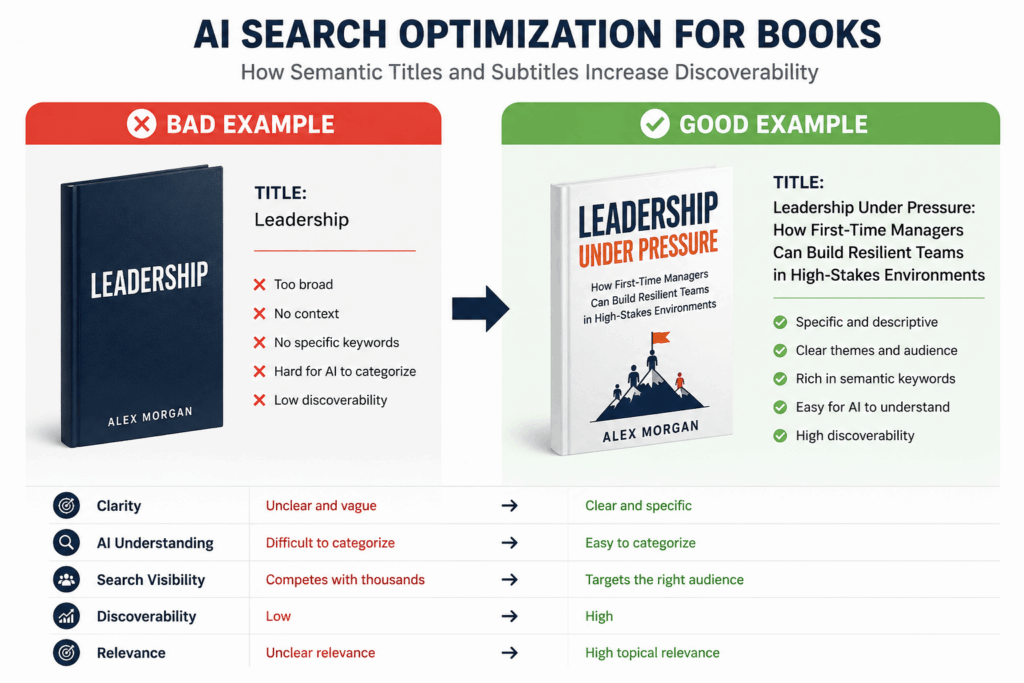
Semantic Titles and Subtitle Optimization
The single most powerful thing you can do for AI discoverability is write a semantically descriptive title and subtitle. AI search systems do not guess what your book is about; they process the explicit language in your title, subtitle, and metadata to categorize and surface your book.
Bad example: “Awakened”
This tells an AI search system nothing. It could be a thriller, a self-help book, a fantasy novel, or a spiritual memoir. It will compete with thousands of other books using the same word and rank for none of them specifically.
Good example: “Awakened: A Psychological Thriller About Memory Loss and Identity.”
This gives an AI system everything it needs, genre (psychological thriller), core themes (memory loss, identity), and narrative category. It will surface in searches for psychological thrillers, books about memory loss, identity-driven fiction, and related semantic clusters, all without any additional marketing spend.
The same principle applies to nonfiction. “Leadership” is invisible. “Leadership Under Pressure: How First-Time Managers Can Build Resilient Teams in High-Stakes Environments” is semantically rich, topically clear, and deeply discoverable.
5. STEP: Submit or Publish your Manuscript
After proofreading your manuscript, choosing your publisher, formatting your book correctly, and optimizing it for AI search discoverability, the final step is the most rewarding – hitting publish and making your book available to readers worldwide.
What Happens When You Submit to OmniScriptum?
Once your manuscript is prepared according to the publisher’s guidelines then submited Omniscriptum’s dedicated editorial team takes over – you will be assigned to the editor who will review the manuscript, and prepares your book for global distribution. Your book receives an ISBN under their imprint, gets listed on Amazon and their wide network of global distributors, and becomes a legitimate, citable, purchasable publication available worldwide, at zero cost to you as the author.
What to Do the Moment Your Book Goes Live?
Publishing is not the finish line – it is the starting line. The moment your book is live, several actions immediately strengthen its discoverability in the new AI-powered search:
- Share your book’s listing URL across every platform you are active on – your author page, LinkedIn, social media, and any community relevant to your book’s topic.
- Write at least one piece of content – a blog post, an article, or a social post – that describes what your book is about using the same semantic language as your title and subtitle, giving Google’s background AI agents a content trail to follow.
- Ask early readers for honest reviews – review signals remain one of the strongest trust indicators for both human readers and AI recommendation systems.
- Build an author entity – create or update your author profile on Google, Goodreads, and your publisher’s author page so search engines can associate your name with your book as a verified real-world entity
Publishing your book for free online and worldwide is no longer a compromise – it is a legitimate, powerful, and increasingly respected path for authors across every genre and language. With the right publisher, the right formatting, semantically optimized metadata, and a basic discoverability strategy aligned with how AI search works in 2026, a book published for free today has genuine global reach from its very first day online.
The tools are free. The platforms are accessible. The audience is global. The only thing left is to submit and publish.