
The right publishing path depends on three factors: budget, time, and how much creative control you want to keep. Traditional publishing requires no upfront cost from the author and carries the most prestige, but it comes with the longest timeline, the least creative control, and acceptance rates that reject the vast majority of submissions.
Self-publishing gives authors full creative control and the highest royalty share per sale, but requires the author to fund and manage every step alone: editing, design, formatting, and distribution.
Between traditional publishing and self-publishing, another option has emerged: free professional publishing. Usually, these publishers combine professional editorial support with print-on-demand production while allowing authors to publish without upfront fees.
Some companies describe this model as hybrid publishing, while others operate as independent free publishing houses. Understanding how each model works makes it easier to choose the right publishing path.
Hybrid publishing sits between the two: the author and publisher share the costs and the profits, with the publisher providing editorial and production support that self-publishing doesn’t include, while avoiding the gatekeeping and lengthy timelines of the traditional model.
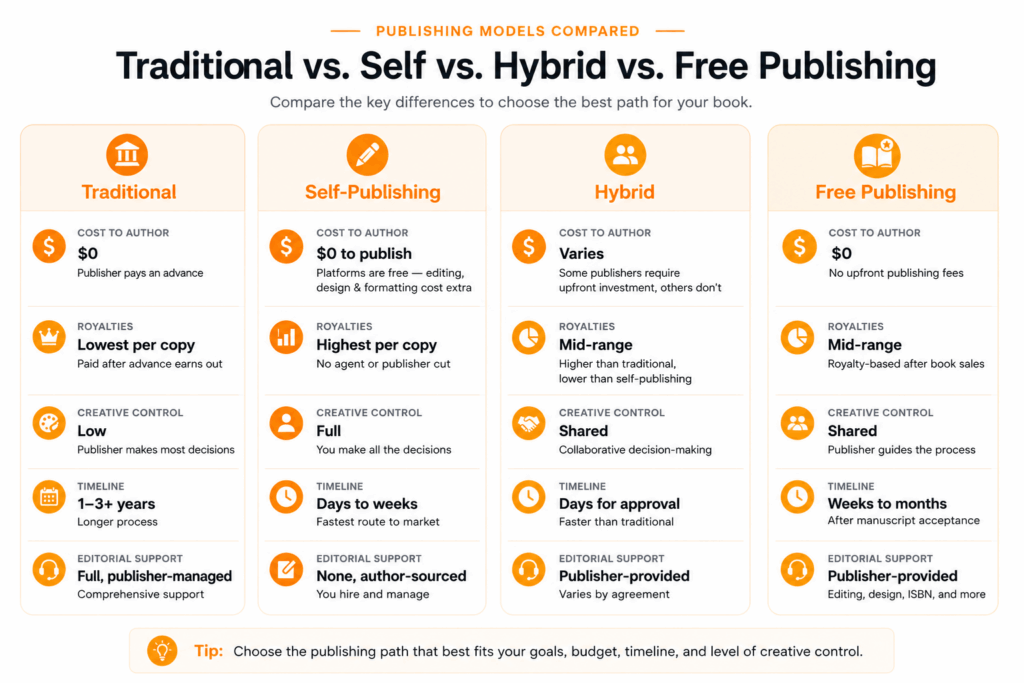
Each model breaks down differently across cost, royalties, control, timeline, and support, a closer comparison of all five makes the tradeoffs clearer. Also in this article you will find a 60 second quizz that will allow you to understand the best publishing path for your book.
Traditional vs. Self-Publishing vs. Free Professional Publishing vs. Hybrid Publishing: Quick Comparison
| Publishing Model | Best For | Cost to Author | Royalties | Creative Control | Timeline | Editorial Support |
|---|---|---|---|---|---|---|
| Traditional Publishing | Mainstream, broad-appeal books | $0 — publisher pays an advance | Lower per copy, paid after the advance earns out | Low | 1–3+ years | Full, publisher-managed |
| Self-Publishing | Authors who want full creative control | High — author funds editing, design, formatting, and marketing | Highest per copy | Full | Days to weeks | None, author-sourced |
| Free Professional Publishing | Authors who want professional publishing without upfront costs | $0 — accepted manuscripts are published at no upfront cost | Varies by publisher | Shared | Weeks to months | Professional editorial and production support |
| Hybrid Publishing | Authors who want professional support and are willing to share production costs | Usually requires an upfront financial contribution from the author | Higher than traditional, lower than self-publishing | Shared | Months to a year | Publisher-provided |
Table of Contents
Traditional Publishing Explained
Traditional publishing runs through established houses like Penguin Random House, HarperCollins, Simon & Schuster, and smaller independent presses. The publisher acquires the rights to your book and funds everything: editing, design, printing, distribution. You write. They build.
How the Traditional Publishing Process Works?
The process moves through four stages:
1. Finding representation. Fiction authors need a finished manuscript to query agents. Nonfiction authors pitch with a proposal and sample chapters. Most major publishers won’t look at unagented submissions — smaller presses sometimes will.
2. The deal. An agent pitches your book to publishers. If one bites, you negotiate a contract: advance, royalty rate, rights.
3. Editorial and production. An in-house editor reshapes the manuscript with you. Design, production, and marketing teams build the physical and promotional package around it.
4. Launch. Sales teams secure bookstore orders before the release date. Distribution gets the book onto shelves.
Start to finish: usually one to three years.
Cost and Royalty Structure
This is the model’s biggest selling point, it costs you nothing upfront.
Agents work on commission, not fees: 15% domestic, 20% on foreign rights, and they only get paid once you do. Publishers pay an advance against royalties when the contract is signed, yours to keep no matter how the book sells. After that, you earn nothing further until the book “earns out,” meaning royalties and subsidiary income (translation, film, audio rights) surpass the advance. Once it does, royalty payments begin.
Creative Control and Timeline
Here’s the tradeoff: no money out of pocket, but very little say in the result.
Publishers typically control cover design, hold final or near-final say on edits, and have significant influence over title and marketing. You’re not driving – you’re in the passenger seat of a process built around what’s commercially provable, not what you personally want.
What you get in exchange is real distribution muscle: shelf space in physical bookstores and libraries, something self-publishing rarely achieves and most hybrid models can’t fully replicate either. The price for that reach is patience. A year is the optimistic case. Two to three is normal.
Self-Publishing Explained
Self-publishing flips the traditional model entirely. There’s no acquisition process, no gatekeeper, no advance. You fund the book, you build it, you own every decision, and every outcome.
How Self-Publishing Works?
Six tasks sit on the author’s plate, either done personally or outsourced to freelancers:
1. Editing: developmental editing and copyediting.
2. Interior design: formatting the manuscript for print and ebook.
3. Cover design: the single biggest factor in whether a stranger picks up your book.
4. Cover copy and marketing materials: the blurb, the metadata, the ad copy.
5. Pricing and platform strategy: where to sell, and at what price point.
6. Marketing and promotion: the part most authors underestimate.
Most self-published authors publish through major self-publishing marketplaces, for example, Amazon’s platform being the largest by volume, or through distribution services that push a single upload to dozens of retailers and library systems at once. Once the six core tasks above are finished, publishing itself is nearly instant: upload the files, set your price, and the book can be live for sale within days.
What It Actually Costs to Self-Publish Well
Free to publish doesn’t mean free to publish well.
Professional editing, cover design, and formatting typically run into the thousands of dollars when done properly. Authors can cut costs through bartering, DIY design, or self-editing, but something always gives: money, time, or quality. There’s no version of self-publishing that skips all three.
It’s also worth being clear-eyed about return: spending several thousand dollars upfront doesn’t guarantee you earn it back. Self-publishing is a real financial bet, not a side hustle with zero downside.
Creative Control and Timeline
This is where self-publishing wins outright. Cover, title, edits, pricing, release date, every call is yours. If you have an exact vision for your book and zero interest in compromise, this is the only model that guarantees you get it.
Speed matches that control. While traditional publishing measures its timeline in years, self-publishing measures it in days or weeks from finished manuscript to live listing. The constraint isn’t the platform; it’s how fast you can get editing, design, and formatting genuinely finished.
Hybrid Book Publishing Explained
How Hybrid Publishing Works?
A hybrid publisher offers some of the same services as a traditional house – editing, cover design, production – but the financial structure flips. Instead of paying the author an advance, many hybrid publishers ask the author to cover some or all of the production costs upfront.
In exchange, the author typically keeps a higher royalty per copy than traditional publishing pays, while still getting professional support self-publishing doesn’t include.
Most hybrid publishers also rely on print-on-demand production rather than traditional offset print runs. A copy gets printed only when it’s ordered, which removes the need for the author or publisher to pre-fund and store large inventory, one of the reasons hybrid models can offer faster turnaround than traditional publishing’s pre-order, bulk-print cycle.
Cost and Royalty Structure Compared to Traditional and Self-Publishing
Lay the three models side by side and the pattern is clear: traditional publishing costs the author nothing but pays the lowest royalty rate relative to retail price; self-publishing costs the most upfront but pays the highest royalty rate; hybrid publishing sits in the middle on royalties, except cost is where the model varies the most.
Some hybrid publishers require a substantial upfront investment, often a few thousand dollars, before a manuscript moves into production.
Free Book Publishing Explained
How Free Book Publishing Works
Click each step to learn how free profesional publishing works and where OmniScriptum fits into the process.
1
What Is Free Publishing?
+
Free publishing allows authors to publish professionally without paying upfront publishing fees. Instead of funding editing, formatting, and production themselves, authors submit their manuscript for editorial evaluation.
Many free publishers use print-on-demand (POD), which means books are printed only after an order is placed. This removes the need for expensive inventory and makes professional publishing more accessible.
Accepted manuscripts are published at no upfront cost while receiving editorial support, ISBN assignment, print-on-demand production, and worldwide distribution.
2
Editorial Evaluation
+
Unlike self-publishing platforms that publish instantly, free publishers review each manuscript before acceptance. This evaluation helps determine whether the manuscript fits the publisher’s editorial standards.
3
Professional Production
+
Once accepted, the publisher manages editing, interior formatting, cover preparation, ISBN assignment, metadata optimization, and prepares the book for publication.
4
Print-on-Demand Publishing
+
Books are produced only when customers place an order. This eliminates warehousing costs, avoids unnecessary print runs, and allows books to remain available worldwide.
5
Worldwide Distribution
+
After publication, books become available through global distribution channels. Readers can order printed copies online while authors benefit from professional publishing without upfront production costs.
- ✔ No upfront publishing fees
- ✔ Editorial support
- ✔ ISBN assignment
- ✔ Print-on-demand production
- ✔ Worldwide distribution
- ✔ Royalty-based publishing model
Cost and Royalty Structure and Where OmniScriptum Fits Among Free Professional Publishers
The defining characteristic of free publishing is that authors are not required to pay upfront publishing fees. Instead, publishers recover production costs through book sales and share royalties with authors in accordance with the publishing agreement.
This distinguishes free publishing from many hybrid publishing models, where authors may be asked to contribute to production costs before publication. For example, OmniScriptum publishes accepted manuscripts without charging authors for editorial production while offering royalty-based publishing agreements.
As with any publishing contract, royalty rates, rights, and distribution terms vary between publishers, so authors should carefully review each agreement before signing.
Which Publishing Path Fits You? Take the 60-Second Quiz
Can You Move Between Publishing Models?
Picking one model now doesn’t mean you’re stuck with it. Authors switch between traditional, self-publishing, free and hybrid publishing constantly, more than the “pick a lane” advice online suggests.
Self-publishing first doesn’t kill your shot at traditional publishing later, but it isn’t a guaranteed pipeline either.
Publishers want proof: thousands of copies sold, real traction. Without that, an agent is usually more interested in your next manuscript than the one you already put out yourself.
Moving between hybrid and self-publishing is easier. You hold the rights either way, and the retailer relationships transfer cleanly. Plenty of authors mix models project by project; hybrid for the book that needs an editor’s eye, self-publishing for the quick follow-up, traditional if the right deal comes along. None of these doors close behind you.
Frequently Asked Questions
No. Both ask the author to fund some of the production cost, but that’s where the overlap ends. Hybrid publishing comes with a dedicated editor, design support, and production handled by the publisher — work a self-published author has to find and pay for separately. The imprint differs too: self-published authors publish under their own name, hybrid publishers release the book under their own imprint with their own ISBN.
Self-publishing typically pays the highest royalty percentage per copy sold, since there’s no agent commission and no publisher taking a cut for production or distribution services. Hybrid publishing generally pays a higher royalty than traditional publishing but lower than self-publishing. Traditional publishing pays the lowest per-copy royalty, but is the only model where the author receives money, the advance, before a single copy sells.
The 90/10 rule describes how roughly 90% of a traditional publisher’s revenue comes from just 10% of the titles it publishes — typically the established bestsellers. The other 90% of an author’s books generate the remaining 10% of revenue. This is part of why traditional publishers are so selective in what they acquire, and why most submissions get rejected: a publisher’s business depends on a small number of high-performing titles, not a wide spread of modest sellers. It’s also why authors outside that top 10% increasingly look at self-publishing or hybrid publishing, where success doesn’t depend on being one of a publisher’s few bestsellers to get published or to earn a meaningful royalty.
Yes. Switching to hybrid publishing is generally straightforward, since the author already holds the rights to the manuscript. Switching to traditional publishing is possible but harder, and typically requires either a strong sales track record on the self-published title or a new manuscript to pitch fresh, since publishers are usually less interested in acquiring a book that’s already been on sale for some time.