
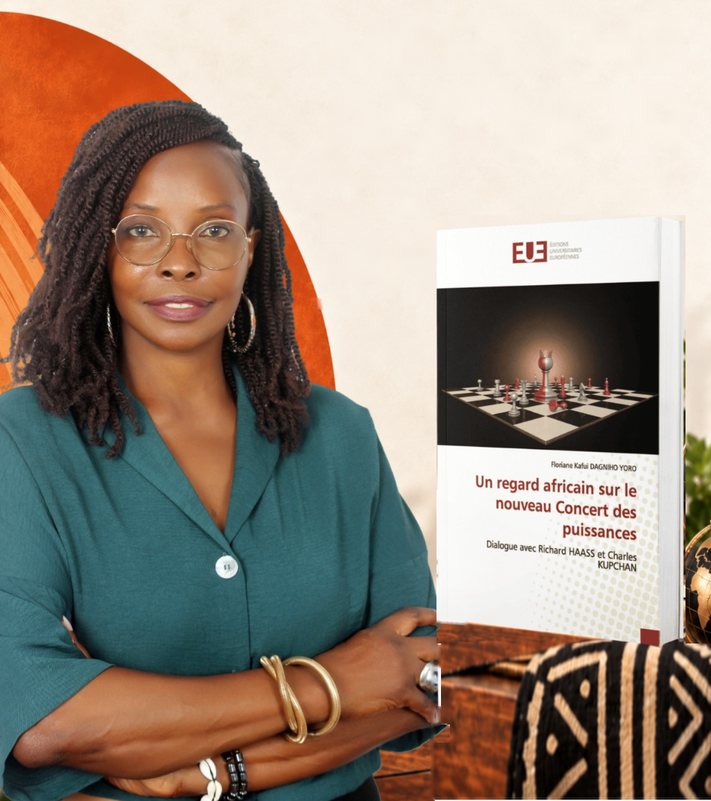
Turning academic research, such as a PhD dissertation or master’s thesis, into a published book means rewriting it for a new reader.
A dissertation proves the author’s competence to a small examining committee. A book has to engage and persuade a wider academic or specialist readership.
For Dr. Floriane Kafui Dagniho Yoro, that shift began in 2021, when the loss of a friend and closed borders showed her that global crises are never far from home.
Who is Dr. Floriane Kafui Dagniho Yoro?
Dr. Floriane Kafui Dagniho Yoro is a Beninese lecturer-researcher specialising in international strategy and security.
She completed her doctorate in international relations and diplomacy at HEIP (Hautes Études Internationales et Politiques) – CEDS (Centre d’Études Diplomatiques et Stratégiques) in Paris, France. She now teaches and does academic work in her home country, Benin.
Her doctoral thesis, Multipolarité et gouvernance mondiale (Multipolarity and Global Governance), analyses how the international order is built and where Africa fits within it.
Dr. Dagniho Yoro is also active in Beninese politics and promotes women’s rights. Her work on governance and security stresses that African stability matters for global balance.
Why did she turn her research into a book?
The book grew out of a personal experience in 2021. That year, she lost a friend, and closed borders kept her apart from her children.
The experience showed her how quickly global crises reach into everyday life.
This convinced her that the world’s challenges and Africa’s future are closely connected.
Her book turns that observation into an academic argument for a wider audience.
"Africa is at the heart of the world. This publication is both the conclusion of a work and the beginning of a dialogue with female readers."
What is Un regard africain sur le nouveau Concert des puissances about?
Un regard africain sur le nouveau Concert des puissances (An African Perspective on the New Concert of Powers) asks what place Africa holds in a rebuilt international system.
The subtitle, Dialogue avec Richard Haass et Charles Kupchan, sets up a conversation with two US foreign-policy scholars who have argued for a new “concert” of major powers. Dr. Dagniho Yoro answers that debate from an African perspective.
What is the “New Concert of Powers”?
The New Concert of Powers is a geopolitical concept for a world in which several major powers compete, negotiate and cooperate to shape international relations.
The term comes from the Concert of Europe (1815–1914). After the Napoleonic Wars, Europe’s major powers used this diplomatic system to keep a balance of power and prevent large wars.
Today, the New Concert of Powers describes a changing global order shaped by several influential countries. Dr. Dagniho Yoro’s book asks where Africa fits in that order.
"An African Perspective on the New Concert of Powers examines Africa’s place in a reshaped international system. I argue that Africa must be a strategic player, able to defend its interests and contribute to global governance."
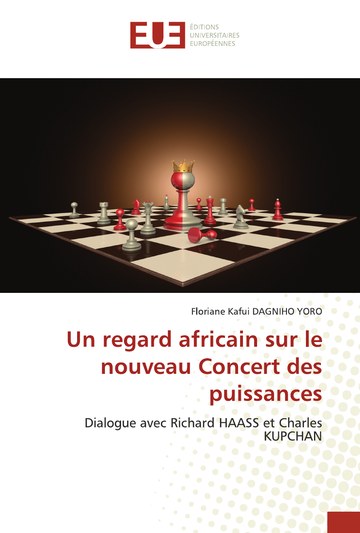
 Buy on MoreBooks
Key facts
| Imprint | Éditions Universitaires Européennes (EUE), an imprint of OmniScriptum Publishing Group |
|---|---|
| Published | 13 November 2025 |
| Language · length | French · 248 pages |
| ISBN | 978-620-8-46996-2 |
| Format | Paperback, print-on-demand |
| Rights | Copyright © Floriane Kafui Dagniho Yoro (author) and © 2025 Dodo Books Indian Ocean Ltd. and OmniScriptum S.R.L publishing group (publishing rights) |
| Where to buy | Amazon, Morebooks, La Boutique Africa Vivre and other online bookshops |
What was her experience publishing with OmniScriptum?
My experience with OmniScriptum has allowed me to transform academic research into an accessible work, without sacrificing scientific rigor.
OmniScriptum publishes eligible manuscripts with no upfront publishing fees. Authors keep their copyright and earn royalties on eligible sales. The publisher holds the publishing rights needed to print and distribute each book.
Why Éditions Universitaires Européennes?
Éditions Universitaires Européennes offered four things that match Dr. Dagniho Yoro’s project: publishing in French, no cost, author copyright and international availability.
From manuscript to published book: the timeline
- 1Manuscript submitted to Éditions Universitaires Européennes
- 2Reviewed and accepted by the editorial team
- 3Prepared for print and ISBN assigned
- 4Published and sold online13 November 2025
What was the hardest part of publishing academic research?
The main challenge is rewriting a thesis as a book. Authors usually shorten the literature review, cut repeated methodology and rebuild chapters around one clear argument.
For Dr. Dagniho Yoro, the challenge was making her work on Africa and global governance accessible without losing its scientific rigour.
What advice does she give first-time authors?
- 1If your thesis answers a question people outside your field care about, turn it into a book so it reaches readers beyond your university’s repository.
- 2If you write best in French, publish with a French-language imprint so readers meet your argument in its original form.
- 3If you worry about losing academic depth, keep your evidence and sources, and simplify only the language and structure.